

This is Olive.
She has a bit of a story to tell: In August 2010, she entered a Southern California shelter as a stray with puncture wounds on the back of her thigh. We're assuming a dog grabbed her from behind when she was out on the streets, most likely as she was trying to get away from those teeth. It's anybody's guess what happened to her, but her shelter intake notes tell us that she was quite shaken when she arrived. Four days later, she stared pointedly at a dog during her evaluation. She stiffened, gruffed and threatened, "Back off, or else." Based on that reaction and her general discomfort around dogs, her evaluator determined that she was dog aggressive.
Because this shelter embraces a no-kill mission, she was set to live out her life in the kennels until she could be adopted. Because she was labeled as dog aggressive, it was going to be a long looong wait.
As far as we can tell, there was no game plan for socializing Olive to other dogs once she flunked that part of her evaluation. There would be no training classes, play sessions, group walks, off site visits or quiet time next to quiet dogs. A note on her intake form revealed that Olive was sensitive and flinched at loud noises. She was kenneled in the middle of the usual shelter chaos, with clanging kennel doors and barking dogs on either side of her and across from her. A half wall separated her from her neighbors, just tall enough so she could argue with them if she jumped - or, if the other dog jumped up to argue with her.
 Olive was isolated in a secluded location in the back of the shelter. Because of her presumed behavior with dogs, no one was allowed to take her out without special permission. Her only daily exercise was a quick 15 minute visit to a small side yard. As the months wore on, she would flatten herself to the ground as she was moved from the kennel to the yard, shrinking from the barking along her path. She was shut down and would not return her handler's affection, but she would roll over for belly rubs. She would ignore the toys they offered her. She would then slink back to her sterile kennel and wait another 23 and three quarter hours to go outside again.
She didn't attend adoption events, and families that spotted her photo on the shelter's website were warned away because of her initial evaluation. During these months in isolation, she was only able to interact regularly with three people. She had no toys or bedding in her kennel, so she relieved her tedium by jumping up and down and barking at neighbor dogs, nearly tearing a ligament in her knee.
Olive's shelter file lacks any notes on behavior and training efforts, but is thick with info about vets visits. It seems her health suffered during her internment. She developed a rash on her belly and an infection on her vulva from sitting on a urine soaked floor. Her toes became swollen. Her eyes were constantly running. She battled multiple ear infections. She was treated for these issues and received pain meds for the knee tear. She was spayed and microchipped. The vet was alerted in big bold type to be aware that she was 'DOG AGGRESSIVE USE CAUTION.'
After nearly two years in this situation, the shelter's board started wondering what to do about Olive and five other dogs who were in the same boat. A solution was found: As part of their mission she could not be euthanized, but she could be moved to a place that would kennel her for life. A 'no-kill sanctuary' was identified just outside of Houston, Texas. For a sizable down payment plus eighty dollars a month, Olive would live in a dirt floor pen with a plywood doghouse, surrounded by similarly rejected and kenneled dogs. If she lived out her life expectancy, she would spend the next dozen or more years inside this pen. She would never leave it for training, exercise, walks, new adventures, socialization, or adoption events - but because she was still alive, the arrangement would fulfill the shelter's philosophy and monthly upkeep checks would be sent.
 So long story short, Olive's five neighbor dogs were sent to Texas, but just before she was supposed to follow them, fate intervened and she ended up in our Rescue Barn.
She arrived here Jan 5th, so is three weeks into unraveling from her ordeal over the last 18 months. We've been watching her melt off stress like a snowman in July. She was initially guarded when she arrived and flinched easily. She stared our dogs down as if waiting for them to launch (they didn't of course). She ran her first zoomies in months, then tail tucked and darted away from some unseen danger. She fluctuated between being ridiculously happy and stiff and wide-eyed worried, as if waiting for the other shoe to drop. She was essentially acting like a crisis survivor with post traumatic stress disorder.
 Dogs are better at letting go than we are though, and with a little support, we can help speed up the process. Within days, after a lot of sleep and some time taking stock of her new surroundings, she started greeting the on-site dogs with wags and friendly interest. Instead of loud barking, she listens to jazz on the radio, visitors' voices and the whirl of a washer/dryer now. She sleeps on a chair in her kennel fluffed with blankets. She nibbles on fresh grass. She tosses toys in the air and sparkles for her new human friends. She watches the sun rise through the barn window and as the day opens up, she peers out on the dogs' morning play sessions.
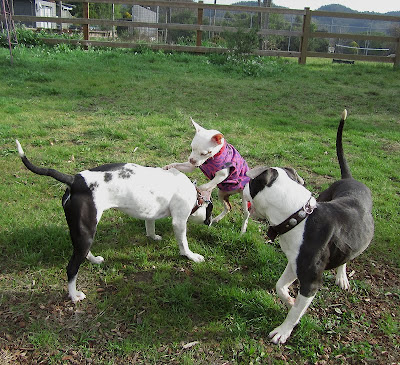
After proper intros, her first full contact (on leash) dog greet was with Elliot. She danced and wagged for his attention. She nosed small dog Blink through her kennel and softened. When she met new boy Clive through her kennel, she acted like a love sick school girl. "Squee! He's so sexy. He smells so good. I want to meet him!" A week after Clive was neutered, they had their first play date. A few days after that, she had her first play session with Blink. She hasn't been able to stop smiling.
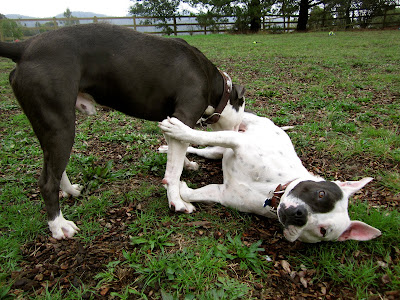
Her play style is clumsy and awkward, but in true dog fashion, the others have been showing her the ropes. "This is how you play bow." "This is how I tell you that I want you to take it down a notch." "This is what the chase game is!" Because it's likely that Olive wrestled with her siblings when she was a pup, she remembers.


Olive's life was put on hold when she entered the SoCA shelter. Instead of finding comfort and opportunities to succeed with other dogs, she was asked to endure a very lonely, highly stressful existence that very well could've destroyed her mind. Our team is treating her as if she were from a cruelty case right now, since her initial behavior matches what we've seen coming out of these cases. Not unlike victims of hoarding and dog fighting operations, dogs from longterm kenneling situations can initially act unsettled, fearful, hyper-sensitive and undersocialized after lengthy exposure to noise and to other stressed dogs, especially with no chance to develop or practice normal relationships with dogs or people.


Olive's life was put on hold when she entered the SoCA shelter. Instead of finding comfort and opportunities to succeed with other dogs, she was asked to endure a very lonely, highly stressful existence that very well could've destroyed her mind. Our team is treating her as if she were from a cruelty case right now, since her initial behavior matches what we've seen coming out of these cases. Not unlike victims of hoarding and dog fighting operations, dogs from longterm kenneling situations can initially act unsettled, fearful, hyper-sensitive and undersocialized after lengthy exposure to noise and to other stressed dogs, especially with no chance to develop or practice normal relationships with dogs or people.
On a positive note, Olive loves to play and the happier she is, the more well grounded she seems to get. Whether she can get caught up with enough life skills to enjoy the bigger world is still an unknown, but we're hopeful. For now, we're just asking her to decompress and learn how to be a dog again.
The Five Freedoms


The Five Freedoms
Progressive shelters follow the 'Five Freedoms' as a basis for humane care of their animals. It was originally drafted in Britain way back in the 1960's as a best practices guideline for housing farm animals. Zoos refer to it as a guidepost for their operations, as well. The Center for Shelter Dogs promotes the Five Freedoms and explains that understanding a dogs' basic needs "will enable shelter staff and organizations to not only manage the (dogs') stress, but all to improve their welfare by addressing their needs."
Five Freedoms for Captive and Kenneled AnimalsFreedom to enjoy the company of an animal's own kind gets skipped in most busy shelters. Dogs are highly social creatures who've evolved as a species to depend on relationship for their very survival, not only with other dogs, but with humans. (Recent science tells us that their domestication started as long as 33,ooo years ago. Link) It's not surprising that behaviors will degrade when they're denied opportunities to socialize.
1. Freedom from Hunger and Thirst – by ready access to fresh water and a diet to maintain full health and vigor.
2. Freedom from Discomfort – by providing an appropriate environment including shelter and a comfortable resting area.
3. Freedom from Pain, Injury or Disease – by prevention or rapid diagnosis and treatment.
4. Freedom to Express Normal Behavior – by providing sufficient space, proper facilities and company of the animal's own kind.
5. Freedom from Fear and Distress – by ensuring conditions and treatment which avoid mental suffering.
We need animal shelters, even though they really are one of the most unnatural places any dog can find herself. The constant stress and isolation can spiral any dog into anti-social behaviors, especially if the dog came from a bad start. Instead of blaming the dog (or the breed!), it becomes the obligation of animal welfare workers - especially those who profess to be no-kill - to work to meet all of their shelter dogs' many needs and to acknowledge when an environment is doing more harm than good. It's a challenge, for sure - This work takes an incredible amount of time, human resources and regular soul-searching reality checks. But simply kenneling dogs to keep them alive "no matter what" betrays the very mission of providing compassionate solutions to dogs-in-crisis in the first place.
Following up: The shelter that housed Olive is said to be reviewing their policies regarding their care of undersocialized dogs, and we support them in this endeavor. We hope Olive made a difference in some small way. Whether they decide to send more dogs just like her to the Texas sanctuary for a lifetime sentence is an unknown.
Meet Olive in this video, enjoying the tail end of her first play session with 'Blink.' Please wish her well. She's come a long way, and we'd love to see her go the distance.
Meet Olive in this video, enjoying the tail end of her first play session with 'Blink.' Please wish her well. She's come a long way, and we'd love to see her go the distance.
UPDATE: Video below of Olive's first play session in a group, filmed in March 2012. And news. Olive has found a home. She's now living with a male elderbull named Zoolander and cats and a couple who are thrilled to have her in their lives. We are over the moon.
Unfortunately, the shelter where she came from continues to send dogs in their care just like Olive to the Texas sanctuary (Smiling Dog Farms). The public is not allowed to view the dogs that live there, so the conditions that they endure are an unknown.
And a VIDEO - Lessons from Olive - . that outlines the steps we took to help her learn how to be a dog again. Thanks to all who cheered her on from your corners.


80 comments:
My heart just breaks for dogs like Olive, but I'm really heart broken for the dogs sent to Texas. How could those workers / volunteers walk by Olive's cage every single day and not do a thing? Something is very wrong with this picture and I hope this shelter will make positive changes soon.
So amazing and well written, THANKS for sharing! First impressions so often can be wrong, or at the very least, are not the whole story and this is a great reminder of that. Dogs tell us much more in their reactions to their environment, in each moment--and blessing of blessings, this allows us a chance to encourage success if we take it. No guarantees, of course. What is perhaps most surprising is that any dogs at all can shine in certain shelter environments. Olive is one lucky gal. =) Your barn sounds like a wonderful welcome retreat (for 2 leggers as well as 4 leggers). ;)
Thank you, thank you, thank you, once again, for all that you do. I'm so glad that Olive is playing with dogs already and shedding her stressful experience. I hope very much that her experience, backed by your advocacy and national reach, may decrease the number of cases where spooked dogs like her get labeled, rejected, and never given an opportunity to change.
You guys are awesome. Just saying.
Good job for giving Olive a third chance! It was not perfect, but the original shelter, with their no-kill policy, saved her life the first time. The Texas Sanctuary saved her life the second time and BADRAP saved her life the third time. Sometimes that is what it takes.
We don't exactly consider this to be a victory or a save, since Olive's fate is still up in the air. But we are grateful that our program gave us a way to spare her from the loneliness and stress she was enduring in the kennel all these months, and the added stress she was headed for in Texas.
So first the "no-kill" shelter warehouses her under conditions guaranteed to stress her and make their "evaluation" of her a self-fulfilling prophecy, then once they've screwed her up as much as they can they decide to send her to a place where she would deteriorate even more while living under conditions that would have been unbearable. How . . . humane. WooHoo, they didn't euth her. They just tortured her.
Yvette
Olive reminds us that just being alive isn't good enough! In order for no kill shelters to be humane, we have to provide a life for them, not just stash them in a filing cabinet under the label 'no kill' and pat ourselves on the back for "saving" them. If we don't do the real, hard work (thorough evaluations, enrichment, play groups, b-mod, foster care, etc.), particularly for long term or lifers, then we're still killing them - but not with a needle - the death is slower and psychological. It's like bleeding to death from a thousand cuts. We owe them more than that. Thank you for writing about this. Thank you for letting Olive know what really living feels like. L'chaim!
Beautiful girl!! I've seen this story unfold too many times when I volunteered at my local shelter. So sad. Most of those dogs didn't get a second chance or a happy ending.
Bless you BADRAP for giving this sweet girl a chance!
Go, Olive, go! She's got a humongous smile on her face. that just makes my heart sing.
Bravo to the shelter to at least acknowledging the need for change. Let's hope they act on it.
Thank-you so much for sharing Olive's story. Cases like this are so tragic, and it's so lucky for Olive she's been allowed to practice being a 'real dog' and go on to find a home. Long term kennelling of dogs is almost as saddening as convenience euthanasia.
No words for how honest and excellent Donna's post is.
This dog was tortured. For months. By people too busy polishing their halos to get a clue. My heart aches for the dogs sent to Texas. The "sanctuary" sounds as if it were modeled on a Depression-Era roadside zoo -- or Guantanamo. Holy crap, I'm so angry right now.
Hope Olive makes it.
Donna, this video made me cry over my morning coffee. praying Olive makes it to adoptable status and so happy to see that big goofy grin on her face. Bad Rap brings such joy to the lives of a chosen few, I wish every dog had the opportunity to work with an amazing group like yours. and as a sidenote...OMG, Blink is just the cutest little thing, love her!
What a sad, sad story--I do hope we learn to do better for these dogs (and cats). Olive is just too adorable with her black chaps and little white tip on her tail--I so hope for her happing ending. She deserves it.
Krista
Just because a shelter doesn't kill for space doesn't make it "No Kill." Part of the No Kill equation is to constantly re-assess dogs and provide them with enrichment. To characterize warehousing as "No Kill" is simply unfair to all of the shelters that are busting their butts trying to reduce the number of dogs who are killed for space. I would embrace these 5 goals. The shelter where I volunteer has recently started the "Open Paw" program which provides dogs and cats with mental stimulation and works up to getting the dogs out in the community for walks. Every Tuesday at 11 am the training staff and volunteers do a "pack walk" with as many dogs as they can manage. That kind of enrichment and interaction is as much a part of the "No Kill" equation as is sparing the needle.
And thanks again for saving her and little Blink. What a pair.
Dianne - I understand. Although this shelter, its donors, volunteers and public all wear the badge of no-kill. Same with the sanctuary in Texas. It's become a very confused word, for sure.
These are from Open Paw. What do you think?
Minimum Mental Health Requirements for Shelters
For Dogs
• A comfortable bed or den
• At least three daily opportunities to use a dog toilet area (outside of their kennel) and be rewarded for using it
• Sufficient entertainment (environmental enrichment or occupational therapy) including stuffed chew toys, such as Kongs or Big Kahunas
• Hand feeding, with any leftover food stuffed in chew toys, i.e., no feeding from bowls
• Interaction with at least 20 people each day, including at least 5 unfamiliar people
• Handling and grooming by at least 3 people a day, including 1 unfamiliar person
• Daily education (basic manners training) and mental stimulation (walk)
• Quiet kennel "downtime" each day (scheduled breaks from the public)
• At least 20 minutes out of their kennel run each day, used either for training, socialization, playtime, exercise or "downtime" in somebody’s office
• Canine companionship: once your shelter is implementing the other Minimum Mental Health Requirements regularly and reliably, you may want to begin to incorporate weekly, 20-minute play/train sessions between dogs.
• Puppies less than 4 months old must be housed together in a self-training, long-term confinement area, with constant access to a puppy toilet area, and fed only by hand (during classical conditioning and training) or from stuffed chew toys (i.e., no feeding from bowls). Puppies require daily handling, grooming, and manners training by at least 5 unfamiliar people. Puppies should be home fostered whenever possible.
If a shelter has the resources to do Open Paw, more power to them, although asking a dog to interact with 20 people a day and grooming by 3 is potentially stressful to dogs in recovery especially. We wouldn't want that amount of disruption and interaction for our dogs.
It never ceases to amaze me how dogs can endure so much at the hands of humans and still bounce back. I know Olive has a ways to go but I truly hope her story has the happy ending that she so deserves. And I hope even more that her story serves as a lesson to those who are involved in the rescue care and housing of shelter dogs, that it's not enough to just be alive, that there also needs to be quality of life as well. Thank you to Bad Rap for all that you guys do for each and every single dog that passes through your hands. You are making a difference one dog at a time!
If the choice is between warehousing a dog and euthanizing a dog, sometimes euthing is the kinder alternative.
Yvette
Olive has a chance now and that's so much more than she had before coming to Bad Rap. So many shelters start out with the best of intentions, only to fall under the weight of responsibilities. No excuses for the numbing experiences these amazing dogs have had in those shelters, just sadness that it takes the telling of a story like Olive's to make the shelter's sit up and take notice of where they've fallen to. The work you do at Bad Rap is amazing. Thank you for all you do. You save and change lives, everyday, whether personally like with Olive or through example for other shelters. I'm awed by the work you do.
wag wag wag wag wag wag wag wag wag wag wag wag wag wag wag wag
I'm so glad Olive is getting another chance. I know my local shelter did a lot of hard work with one of my dogs over the course of 6 months, teaching her that terrified panic wasn't the appropriate response to everything she encountered. I hate to think of what would have happened to her in Olivia's situation. Today Kyra's happy and well-adjusted, so I have high hopes for Olivia.
Very well written with some important information missing. I know as I'm one of many volunteers helping dogs like Olive get through a very difficult time. I agree with much of your story but we live in a less that perfect world. We are in the trenches here with no end in sight due to irresponsible people abandoning their dogs on small shelters like ours.
Question, Donna, can you outline your procedure in evaluating a new dog with no history. Can you also outline your methods of determining when you would have to euthanize.
Thank you,
Kevin....
Thanks for helping Olive, Kevin. We welcome your add'l information.
To your question: We euthanize for unmanageable aggression issues or extreme health concerns. Olive hasn't been 'evaluated' by us to so to speak since she was so rattled when she got here that she just really needed to sleep off a few months worth of stress first. We'd likely also choose euthanize if a dog becomes despondent in his kennel and no qualified foster homes could be found to relieve his suffering.
As an aside, we're very sympathetic and familiar with 'the trenches.' A large part of BR's resources go towards training Berkeley's city shelter dogs, the shelter volunteers and the dogs' adopters. Pit bull types with every kind of behavior and background are constantly flowing in the doors, so we get a lot of practice. ;-) This busy shelter has a 98% live release rate thanks to community-based efforts to exercise, train, socialize and match each and every dog with supported adopters. A great program if you ever make it up to the bay area and want to see what they're doing for dogs just like Olive.
http://www.facebook.com/berkeleyanimals
"It's anybody's guess what happened to her, but her shelter intake notes tell us that she was quite shaken when she arrived. Four days later, she stared pointedly at a dog during her evaluation. She stiffened, gruffed and threatened, "Back off, or else." Based on that reaction and her general discomfort around dogs, her evaluator determined that she was dog aggressive."
Hell, if I'd been pulled off the streets after being beaten, and was stuck in an unfamiliar environment with a bunch of strangers, you'd better believe I'd be suspicious and wary. I'm pretty damn sure I'd have failed a similar evaluation test for humans. How sad that on the basis of this one evaluation done so soon after the trauma, Olive was sentenced, like some prisoner of war, to "solitary confinement". I hope shelters do come to understand that this type of isolation is a form of torture as pointed out in other comments.
I have to believe that shelters do want to provide their wards with the best possible care that they can, so Olives story is an important one. I hope that rather than getting defensive about policies and practices that aren't designed to address the 5 freedoms, Olive's story will help them realize that being humane is more than just being kept alive as pointed out in this blog and they'll make the necessary changes and put in the work.
And BTW, Olives body language in the pictures posted sure give the lie to the label "DOG AGGRESSIVE USE CAUTION".
Just like closing all the horse slaughering facilities in the US proved to be a bad idea because they were shipped to Mexico to be slaughtered - a far worse fate, so the idea of "no kill" may not be all it was promoted to be. How anyone who loves dogs could condemn them to the life described in this posting re. the Texas facility is beyond me. The photos are fantastic as is the story. But I could only shudder - what about her shelter mates sent to Texas? Are they now beyond hope of saving???
I <3 olive
Beautiful Olive and Beautiful Bad Rap. God Bless both. Praying and praying for ongoing shelter reform.
No kills can wreck havoc on animals. They develop shelter shock and burnout from the constant barking and physical neglect. We have a wonderful no-kill, Brother Wolf in Asheville where I live. We also have Animal Compassion Network which utilizes fostering.
This is my dream what Bad Rap provides as well as Shelter Revolution
http://www.shelterrevolution.org/
One problem is that most animal shelters, especially smaller ones, weren't built to house dogs long-term. Even newer ones are still designed primarily as temporary housing -- kennels only as large as the state vet requires. Good news is that many shelters are recognizing that just because a dog has problems, doesn't mean it's unadoptable. But it's a challenge to address many of those problems in a shelter where there's no quiet place to house dogs with special needs. Would love to see shelter designs that incorporate what you do at the barn -- provide a separate area as a transition to the adoption floor or foster home.
Thank you for taking this conversation to the next level Peggy ... 'How can a shelter provide for dogs' needs?' Agree that most shelter settings, large or small, are ill-equipped to deal with dogs that have experienced even moderate trauma, especially if that trauma manifests as a less-than-happy response to other dogs during eval. A solid network of rescues and foster homes can be the biggest help, but until that help can be found, shelters can get creative with housing overwhelmed dogs in quieter spaces - like many do now for new moms and litters. I'm tempted to write an add'l blog with examples. You don't need a barn - a quiet ward staffed with focused volunteers will do. We were able to accomplish that goal for a short time at Oakland Animal Services and it was a lovely thing to see high risk dogs melt off their stress in a traditional shelter full of the usual chaos.
I hope I'm not underselling Olive with this blog post - I don't think that she's as special needs as she's been made out to be. My sense is that she had the right stuff to be 'normal' from the get-go. She just needed a chance to get her bearings and then benefit from proper dog-intros that set her up for success. A cute boy like Clive, for example, might've got her tail wagging and told the staff that she was actually fairly normal - just rattled from her misadventures as a stray. Her longterm exposure to the stress of the shelter was probably more traumatic though than whatever happened on the streets, and that's the tragedy of it all.
Great blog. Sad. Educate people. That is what works.
Donna, Give in to temptation and write that additional example blog post! I've heard myriad shelter/rescue folks giving props to BadRap's positive outcomes while simultaneously lamenting the fact that similar successes just couldn't be possible within their own particular facilities/ budget/volunteer group /pitbull populations. Like NYC bagels -"well,there must just be something in the water in Oakland CA". C'mon people! There is nothing rarefied or precocious about what BadRap is doing. Case in point: the "teach a man to fish" approach described in the previous post. Olive's case is a call to action for animal welfare workers to collectively put our creativity and passion to work.
What a great discussion this has been. Thank you for giving us this forum. I don't think you're underselling Miss Olive at all and we look forward to updates. And yes, write more. The more ideas out there, the better.
BTW, I laughed at the "20 people a day" idea. Indeed.
Okay then. I'd love to hear favorite examples of (other) programs that remedy shelter-related behavior issues. They aren't common yet, but maybe we can help that out some.
In a perfect world these dogs wouldn't be in shelters but if shelters had enough volunteers, money, coordination, getting trainers into the shelters to train these dogs and socialize them, etc. would be the answer. On a regular basis. The shelter I volunteer at has some dogs that have been there six months in the hopes they will be adopted. Some shelters really do try to give these dogs a chance but these dogs need exercise, training & socialization to look better to potential adopters.
Thanks for writing this -- very common occurrence and not necessarily a result of inhumane management, but lack of resources. How impactful would it be if our communities had trainers who could help dogs like Olive with expertise and time?
Since I fostered (and eventually adopted) a dog who went through a similar shelter experience to how the author describes Olive's, and got no help from the "rescue group" who pulled him except an offer to put him in a no-kill sanctuary for the rest of his days, I have now turned my focuses to help more with behavior volunteering than pulling and placing. I see so many rescues get caught in a "Postal Service" mentality of moving dogs as fast as possible, and sending them away if they have an issue that requires special attention.
To me, it's about quality of life, not quantity of lives, and there's ripe opportunity for all of us pet advocates to see how we can help our local shelters provide more behavioral resources to shelter pets in need.
Animal Farm Foundation in New York State runs free internships for shelter volunteers and managers on enriching the experience of shelter dogs. They also bring single day conferences on the subject to the area.
Simon Foundation shelter in Connecticut has an emphasis on training, so they get to know the dogs in their care very well and improve on challenges. They also require follow up training classes for each adopter.
ASPCA shelter in NYC has an amazing behavior department that works closely with qualified volunteers to learn behavior modification techniques to help dogs become more adoptable and more likely to stay in their adopted home, so their volunteer visits are not only spent exercising and socializing, but working through any challenges.
Donna, to your article's point, if a shelter doesn't have enough resources to fully go through behavior modification with a dog, doing regular and thorough evaluations will help tell its story and prevent unnecessary restrictions, such as Olive being labeled dog agressive based off of a few observances. My dog was also labeled dog agressive in the shelter, but his first day home with me he went on a pack walk with 6 other dogs and is a social butterfly on the busy streets of NYC.
Thanks for your list of favorite resources Renee.
Now, had this shelter continued to eval Olive with the same set of eyes and methods used on intake, we're fairly sure she would've shown the same icky behaviors that got her labeled 'dog aggressive' in the first place. She was obviously stressed and telling select dogs to back off in that setting, and as long as nothing changed, why should she? The added stress of confinement would probably give observers reason to believe she did indeed have dog issues: fence fighting, etc. - It's an incredibly common behavior in shelters, it looks bad and it gives the impression that - Yep, she earned that label fair and square.
I don't blame the evaluator for noting what she saw that first day, btw. But what they decided to DO with that information is the crux of the dilemma. More progressive shelters will say, "Okay, this dog has some tension around dogs. What can we do to help her get over it so we can save her life?"
Instead, this particular shelter said "Well, she's not very adoptable with those dog issues so we'll have to put her in the back where she'll stay out of trouble," -- essentially de-socializing her more and making her even more undesirable to potential adopters. All this, until a dog advocate at the shelter noticed that Olive was suffering and started looking around for help.
As an aside, we're not trying to beat up on this shelter (altho it must be incredibly uncomfortable for anyone from that org to see this conversation going on). Sometimes it takes one dog to wake everybody up and recognize that it's time for change.
To your comment about resources. Here's the thing: Build it and they will come. We use Berkeley as an example quite often and I suppose I'll be writing more about it very soon since they're the proof in the pudding -- But just saying "We don't have the resources to help our dogs" is a cop out. Build a program that helps rattled, troubled, dog reactive - what have you - dogs and help will come, I guarantee it.
What a heartbreaking story! Thank you for sharing Olive's journey to a better, more suitable place for her. I wish her the best in her recovery now that she will have time to socialize with people and other dogs.
This is such a wonderful story. Humans are always so quick to judge and forget that dogs live in the moment. Just like humans they have unique personalities no matter what their breed. They also are normally quick to forgive and trust. While I understand that many facilities may not have the appropriate staff to work with the animals, I've also seen many that won't allow volunteers to come in and assist. Many shelters in smaller communities are not volunteer friendly and are only harming the animals by their need to be in control of everything. I volunteered at a very large facility where dogs were only removed from their kennels once per day while it was cleaned. There were other dogs that were being kept in plastic crates that were taken out 3 times per day for a quick 15 minute walk. Fifteen volunteers were there wanting to walk the dogs, pet, groom, train, etc. but were told it was too much stress on the dogs. Some facilities are in way over their heads as far as the number of animals they can properly care for and then refuse any assistance they are offered.
Very nice. So important to remember that assessing is not a label..it is a snap shot in time and IMO it should also include assessing rehabability on said behavior problem.
Well I think my face probably looks a little like Olive's now since I cried all my mascara off. I really hope she can overcome her past and find a home because she seems pretty wonderful. It makes me sad that people (who probably genuinely care about dogs) don't see that we would never treat a human that way - why is it ok for animals?
This makes me incredibly grateful to foster for a really wonderful group. I mean, we foster retrievers, so our biggest obstacle is usually getting people to adopt black and/or senior dogs, not get past major breed stereotypes, but the puppy mill ones suffer from very similar issues. Thank you for doing the incredibly necessary work to really *save* these beautiful dogs. I'm off to give my bad little dog a hug.
Oh, no. It IS a save!
I love your comment on build it and the resources will come. Our training staff lamented that they did not have a budget for high value treats. I told them about using an Amazon wish list. Problem solved! Whenever they are short of treats they send out an email and their wishes are granted. And, Donna, be looking for some bully sticks from me.
thank you for being such a wonderful organization and understands dog's needs, works to fulfill their lives and help them find happiness. thank you <3
Thank you for giving Olive a chance, Donna!
this blog comes at an especially poignant time for me. I just found out a few days ago, there is a buff mastiff mix named Hades who has spent an ENTIRE YEAR incarcerated in a cage with a dog run in Toronto Animal Services here in Toronto. A YEAR. A year wherein he has not been out ONCE. A year left to rot in a cage, NEVER let out, never walked, never exercised, never allowed to interact with anyone. Every time I think of it, I feel physicaly ill to my stomach. We only found out becuase apparently a judge discovered it and demanded he be tested and something done with him - but this is a YEAR later. That poor poor dog has not seen daylight, smelled fresh air, known a kind word or interacted with anyone in all this time - and now they're going to test him.. may I use (with full credit, of course) your rules for a progressive shelter? Poor poor Hades. I'm sick to my stomach about him.
You sure can Selkie. I'm really sorry to hear about the mastiff. Not providing out time and relief from the tedium can have the same effect on dogs that it has on humans -- very few can survive solitary confinement without disintegrating and going nuts.
I can't imagine the dog will show well during an evaluation at this point in his life, but you never know. Dogs continue to surprise us and remind us that they're individuals.
As far as that eval goes, remember that AT THEIR BEST, behavior evaluations (some call temperament tests) are meant to tease out a few basic behaviors in dogs only as a way to give responders enough information to plan next steps including a search for appropriate placement options for each individual. Disposition recommendations are typically broken down into four main categories, including placement into: A) a shelter adoption program B) a foster care home for continued observation, behavior modification and possible adoption placement C) sanctuary for extreme behavior issues or D) euthanasia for a dog that is clearly suffering from medical distress or that is considered unredeemably dangerous.
Sending our best to that dog.
agree completely with your comments, Donna - it drives me nuts that so many shelters use temperment tests as a pass/fail barameter with fail being a quick trip to the kill room. I'm not sanguine about Hades; his owner abandoned him after he was taken in when he got loose and bit someone - and as you indicate, a year of soliatary confinement can't help; further, while in many instances, TAS tries to do its best, it is first and foremost, a POUND, not a shelter. Yet frankly, I think that poor dog is better off dead than living this hellhole of a life. Will keep you posted. and thank you.
What a provacative and insightful post. So much of value has been said: I wish a bullet point two page hand out existed that could go to muni shelter directors as well as the no kill facilities which have sprung up like spring onion patches and jonquils all over the country. I am very happy to see you address the PTSD effect in long term warehoused dogs. Not just for fighting dogs, or SAR dogs. But for those whose daily routine is a survival exercise in noise, cramped space, less than clean floors, deprivation of the most basic simple kindness -- a liitle time and attention from a quiet, respectful human. I see these pictures after only three weeks and am filled with joy and gospel voice to envision OLIVE with ELLIOT, then BLINK, then CLIVE. Thank you for a much needed post. And for all the time, love and respect you guys give these dogs. BTW g r e a t shot of TIM and ELLIOT in the front seat heading out on a road trip. I have a mad crush on ELLIOT.
PepiSmartDog RB (FaceBook) : I very recently interviewed Elizabeth Oliver, Founder of ARK, where she addressed many of the subjects being discussed in this blog and these comments. Read Elizabeth's explanation of when rescue is not rescue.
The article is posted on ARK's page, but here is the link to the actual article: http://pepismartdog.com/news/?p=1299
ARK is a shelter that really does 'care' about the individual animal and it's best interests.
It has been my experience that animal legislation in many states of the US needs drastic overhaul, to say the least.
I am a front line animal rescuer, and have experience in many countries.
Sadly, reading this story about California is absolutely no surprise to me at all !
For people who are offended by my comments, it is 2012 and America still uses Gas Chambers in many of their kill shelters; just like Japan.
*picks up a brick and bangs own head on a brick*
:=o(
Happy for Olive. No kill should not be interchangeable with no life.
the timing of this post is perfection. The rescue I volunteer with has such a dog. He is doing miserably in his adoptive home. I URGED them that he was not ready for placement. They have learned a lesson at his expense. The good news is that he is coming to my home to be integrated into my pack, and mothered by my resident mommy dog, Byrnese. I finally have hope for this poor dog, whose symptoms you mirrored in Olive's story!! Thank you for getting my back, and not even knowing it!!
Thank you, thank you, thank you for posting this. I needed to read it as I struggle to find my own words for the type of "sheltering" I believe in. You are my faraway mentors for dogs of every stripe. Dog bless and happy weekend.
Olive was SO lucky to find Bad Rap. But I can't help but wonder how the other dogs who were sent to Texas are faring.
Wow, Olive is such a lucky dog that she didn't get sent to the "sanctuary" and instead ended up with you. She is a darling dog who deserves a good home. Thanks for this great post. It is very inspiring!
That collar clashes horribly with that outfit!!! But seriously, this is an awesome article that I am sharing with everyone and all my dog rescue groups. One major rescue where I live did the same thing to a dog I absolutely love. After 4 years she just found a furever home! But right before that, she did great at a home visit with my granddog in there fence yard. She was fine with another dog as long as she wasn't cooped up in a noisy kennel. In the end, she went to a family who doesn't have other dogs and is crazy about her!
Sad but true.
And how many of you would give a person this amount of leniency and benefit of the doubt? The five freedoms mentioned above apply to people as well. If we could provide those things to everyone in our communities the world would be a better place.
What the "no kill" shelters and everyone needs to realize is dogs live in the moment. They don't fear death. The don't regret the things they never got to do. They're either enjoying life or not.
The problem is human attitudes towards their own lives and death. Look at how we treat our elderly. It's not about giving them a dignified end to their lives but how many pills, surgeries, and tubes can you shove down their throat till prolong their "lives" for another week, month or however long.
Once we accept that our death is inevitable and that quality of life is truly more important than quantity then we will start to treat dogs with the dignity and respect they deserve.
Olive's story is very similar to the story of a dog volunteers are trying to save at another socal shelter. Please watch Bree's video and share her story!
http://www.youtube.com/watch?v=QYM7Da4WEYU&feature=youtu.be
I adopted my pitbull from a no-kill shelter. When I went to meet the dogs there, I was shown the outside kennels. As I was about to leave, I overheard someone say that one of the dogs in the inside kennels hadn't been walked. When I inquired, they said they don't take visitors to the inside kennels (I fear what the conditions were like in there). I volunteered to walk the dog in need. They brought out an emaciated, dirty pitbull who, despite her condition, wagged her tail and looked me right in the eye. We had a nice (though not very proficient from her end) leash walk, and then she gave me a big sloppy kiss. I fell in love immediately.
Sadie had been in the shelter for two weeks. What I know of her history is that she was found by the side of the road, and looked so terrible that some good samaritans took her right to the local shelter. I don't know what kind of care she got in those two weeks, but I suspect not much. I couldn't crate train Sadie, because even if I left her for a very short period of time, she would relieve herself in her crate, and then huddle in a corner to try to get away from her own waste. I understand this is a sign that she could have been kept in a crate-sized kennel and had been forced to "go" there because she wasn't taken out of it.
If I hadn't been there when someone just happened to mention this dog needed a walk, I don't know what would have become of her. Would she have been in that cage for a year, slowly going mad? It's inconceivable to me that this sweetest dog, held up as a paragon of a great dog by my friends and family (really not kidding -- people LOVE my dog), might have ultimately been tortured (harsh, I know, but what else is it) into insanity, ironically by well-meaning people.
That shelter ultimately was closed when the state did an evaluation and determined there wasn't enough care for the number of dogs they had. I believe the people there cared a great deal about those dogs and were trying to do the right thing, and I believe the dogs needed a place to go, but I wasn't sorry to see the shelter close.
Thank you for bringing attention to this issue, as it needs to be discussed any time no-kill shelter situations are addressed. And thank you for everything else, because I just really, really love you guys.
Donna, I tried to read your interspersed comments and I found all of them just as enlightening and important as the actual story.
I don't think you painted Olive in any light other than what she is - this was a great write up. I loved the video as well.
By sharing these examples, word and ideas will spread. Here's hoping many more dogs will benefit from Olive's story, no matter the outcome.
I am saddened after reading this article to see our shelter portrayed in such a derogatory manner!
Olive was not isolated in some far off corner..we have no off limits areas. She was played with and worked with every day, not just for 15 minutes.We are a small city shelter and have 40 other dogs on a daily basis to also care for. We are not permitted to take most dogs off site due to liability issues. We have dedicated kind volunteers and staff who do the best we can with the dogs that come to us. We live in an area where pits have been poorly portrayed and they are now banned from our military bases...thus many of them are dumped on us. They receive daily exercise, training and lots of love. But,as any one familiar with pits knows, they do not kennel well.We try to provide stimulation like kongs and nyla bones to reduce their stress while in their runs.
I am one of the volunteers who worked with Olive and am thrilled that she has had this chance to have a new life.
There are not too many places set up like BadRapp who can handle and rehab these dogs. We do the best we can and I think we do a pretty good job.
Our adoption rate for even hard to place dogs is great ..we do home visits and follow ups
We did send a few dogs to a couple of sanctuaries and they were both visited and investigated before we would allow our dogs to leave our property. Their living conditions far surpass those at any shelter and to say they were just dumped there is cruel and untrue. We receive regular updates and photos from the administrators to let us know how they are doing.
I wish each of our great dogs could find a forever home, but know this is unrealistic. We do not pretend to be Best Friends etc and are trying to give the dogs in our care happy lives while they are with us.
Anonymous - I understand why you'd be sensitive about this blog post.
One of the things your shelter is very good at is taking meticulous notes, and those 18 months worth of notes, photos of her environment and information provided by her caretakers were very helpful in understanding Olive's history at the shelter and especially, her behavior.
To reiterate: Based on information that was provided as a condition of our rescue transfer, Olive was not one of the shelter dogs that was allowed to be viewed by the public, have toys in her kennel, attend adoption events or exercise out of her kennel for more than 15 minutes a day (as instructed by notes on her kennel door). I have no interest in bashing any shelter or we might've chosen to reveal the shelter's identity - My intent is to use Olive's story to bring quality of life issues to a public forum. This is a hot topic in shelter circles as more and more shelters move away from the catch-and-kill model of sheltering and commit to longterm kenneling.
It's a tired myth that "pit bulls don't kennel well." With few exceptions, NO dogs kennel well. Kenneling is by nature a stressful, unnatural experience. Knowing this obligates every single shelter - mine included - to constantly evaluate each dog's situation so improvements can be made and stress can be minimized. In some cases, shelter staff needs to be trained to recognize signs of stress in a dog first. It doesn't help anyone but the people to make excuses for why improvements can't be made. And blaming a breed when dogs start to disintegrate is just more stereotyping.
When an organization is not able to meet its dog population's needs, then something needs to give. Either the number of dogs accepted into the program has to be drastically reduced and/or the staff needs to look at changing personnel so creative and compassionate solutions can be found and implemented. None of this is comfortable - None of this is fun. But for the sake of the animals who we've all committed ourselves to, we need to want to do a better job. I hope that you can agree with at least that one sentiment - We ALL need to do a better job.
I am a volunteer for the organization who partners with Olive's original shelter. I would like to say that this is the perfect example of why change is necessary and Donna was spot on in her blog. Donna's words may sting for some but I personally know that Olive was treated like a prisoner on death row.
The shelter in which Olive was residing is not a rehabilitation facility. It is a city shelter that houses animals until they are adopted. The establishment and it's volunteers were doing the best that they knew how. Olive pulled at many people's heart strings at a time when most of the pit bulls were being isolated. She exhibited a look in her eye that was so sad and it was obvious she was traumatized and deserved a better environment in which to recover.
As volunteers, we are there as guests of the city and have to abide by their rules. The city has it's own legal obligations and rules to follow. They will suggest an animal be taken elsewhere or dealt with and they depend on the volunteer group to find a way to handle this. Olive was one of those dogs and it took one key volunteer to make Olive's life change forever. Now this was really like winning the lottery for Olive, but it took one person's determination to make it happen. As an organization that helps keep the shelter a no-kill establishment, we are obligated to advocate for the animals we care for. Currently we are providing food and medical for the shelter animals and do help other animals in the community. The organization does some amazing things. But the point of this story is that if you can do all that successfully, why not do more? Donna's words may not be received well by some but it is our job to put forth the effort for change. Who else will do it? The change Donna speaks of would enrich the animal's lives. It will not hurt or hinder anyone. Only good can come of it. If someone's ego is bruised, then so be it. That bruised ego does not belong there if they can't get past their own pride for the better good. I cannot imagine any human who loves animals would not want some positive change. So I hope that anyone who reads this from Olive's shelter that may feel hurt or angry, please let it sink in and realize that not one person is at fault. It was a group effort. The system can change and you can be a part of it.
I believe we need to provide options to those who felt they "had no choice". This blog was an avenue in which Donna could express WHY we need to do better and step up. Humans have the luxury to learn from their mistakes and do better. This is what Olive was put on this earth to do. To teach a lesson to those who cross her path and hear her story. Wouldn't it be amazing if Olive were the reason so many people banned together in her honor to make her shelter a better place? We know some people will learn, some will be angry, and some will be bitter. But as an organization who helps animals, I believe it's time that we evolve. It's a different generation, a different world and it's an opportunity to do better. Thank you, Donna and those who led Olive to you.
Thank you for this thoughtful blog, and for this post specifically.
I am relatively new to the animal welfare community, so please forgive me for any ignorant questions.
I understand from the post that out of 6 dogs, Olive was the only one chosen to go to a 'halfway house,' and the other 5 were sentenced to 'life in prison' at a sanctuary. How was this decision made - what criteria were used? The research I've done so far, about rescue work just generally, paints a picture of processes that are subjective and arbitrary. Often it depends on sheer luck and one person making the right plea to the right person ... not a standard evaluation, consistently applied.
This is not to point fingers at anyone. Only with a view to trying to figure out how to help more dogs. I appreciate very much Bad Rap's commitment to documentation and developing best practice approaches and case studies. I'm just wondering how these can be scaled up, replicated - to give more dogs a better chance.
Hi Anna. I'm grateful that Olive's story has reached you and so many others.
As far as we know, there was no criteria for selecting Olive as a good rescue candidate from the group of six dogs deemed to be 'un-adoptable.' Olive was simply lucky in that a couple of volunteers felt enough attachment that they were willing to stick their necks out and make a plea to us for a transfer. It's certain that she would be in the pen in Texas today if we did not have a spot in our program.
Our entire team has thought of the other five dogs often. What if they had recv'd a chance to be re-evaluated after some decompression time? It's almost certain that some or all of those dogs would have shown some ability to bounce back from the stress of their shelter, but sadly, resources for dogs who need a little TLC are still slim in this country. We hope that Olive's story can help change that some.
You can see through the series of pictures and the story, Olive coming out of her shell. What great work you do! Utmost respect and praise for Bad Rap and the great people you have making lives better for dogs like Olive. Could not be happier that she has finally found a home, as shown on your Facebook page. She is a lucky dog.
I'm so thrilled for Olive! She's gorgeous & such a sweetheart, it's wonderful that she was given a chance to shine! It brought tears to my eyes to see her playing after I read her story. I hope & pray that she is showered with love & is treasured in her forever home! We have a rescue dog & he has required a lot of work & patience, but it's so worth it because he's my heart. I hope Olive's family remains patient so she can continue to blossom!
I live in Houston, TX & I'd like to take a look at the sanctuary you mentioned. I don't know if they take volunteers, but I'd like to get inside somehow (legally, of course!) & document the conditions the dogs are kept in & let you all know. My email is puppyluv122507@yahoo.com if you'd rather not publicly name the sanctuary.
Thank you so much for posting this story. Our 92-lb Moose is 12.5 yrs old, and while we are going to enjoy every day we have left with her, we're also weighing options for her successor.
Moose came to us at 6 years old. She was raised as a single pet in a house with teenagers, and while she had been to obedience classes, she was spoiled and had acquired an attitude. When she was 5, the owners brought a teacup chihuahua into the house, and let it eat Moose's food and chew on her ears. Moose was punished if she defended herself or her food. She became leash reactive, and was no longer taken to dog parks, just kept at home with the new small dog. When she bit a neighbor's dog that had been her friend for years, Moose's owner decided to have her put down. My proposal for letting her be placed with a rescue organization was rejected, so two hours later, I had a Moose in a very small cottage.
Moose moved into a much smaller house with 2 cats and a housebunny. There was no room for a crate, so we leashed her in a section of the living room for an intensive course of "Nothing In Life Is Free". She responded beautifully. Her leash manners were excellent after a few months of consistent sit-stay and down-stay practices. She even learned to stay when squirrels or geese were walking nearby.
Once settled in, Moose accepted the cats and bunny. We are very proud of her, as this was all new to her.
She does remain somewhat leash reactive with dogs, and I wanted to share our "solution" that suits our time constraints/resources. We don't walk on the crowded rec trail that has tons of dogs. We cross the street well ahead of passing other dogs to increase the chances of Moose successfully "looking at me", and we walk in the late evening when the other dog-walkers seem more responsible and fewer extendable leashes are seen. We don't walk near playgrounds with small children. I don't have small children, Moose has never been near small children, and she has a nervous personality...so avoidance is a win-win.
There are a lot of senior citizens in our area, and Moose is recognized and well-liked. I guess what I'm saying is that she does get to see other people and other dogs, just within her boundaries. It is possible if I had more time to devote to working on her issues, that she could be even better dog-socialized and maybe even adapt to small children. However, I think she has a pretty good life with lots of belly rubs, walk-n-sniffs, occasional cat/bunny nose touches, and a memory foam bed. Her 3-person herd loves her!
Olive was lucky to get such great socialization, and it's wonderful she responded so well. It also reminded me that not all dogs are so fortunate, yet can thrive in the right situation. --a good reminder!
how lucky for olive and sad for all the other dogs. you would think the shelter learned something from olive. it has always bothered me how they get labeled aggressive when they are in a high-stress situation and no telling what they came from. i am not a behaviorist but i have common sense and a great love for dogs especially pits because they are so misunderstood, like me. :) can you tell me the name of the
shelter, i live in so cal.
how lucky for olive and sad for all the other dogs. you would think the shelter learned something from olive. it has always bothered me how they get labeled aggressive when they are in a high-stress situation and no telling what they came from. i am not a behaviorist but i have common sense and a great love for dogs especially pits because they are so misunderstood, like me. :) can you tell me the name of the
shelter, i live in so cal.
My heart sings for Olive and Zoolander. I must admit that the mama dogs are my favorites - as the puppies and macho boy dogs get adopted and the girls are left behind. Thank you so much for believing in her - I always believed in you and that you could give her a good outcome.
Great news for Olive and Zoolander. I never doubted Bad Rap would "rehab" her and bring out her strengths. I'm partial to the mama dogs - after all the puppies and the macho boy dogs go HOME the mamas are the last to go HOME. Celebrating Olive's new HOME.
great blog .. interesting post .. thank you
I volunteer for a small non-profit animal shelter (no-kill) and while we are making it financially and taking care of the animals, we don't have adequate volunteers to do all the extras for the dogs and cats, such as regular walking and cuddling.
Animal lovers....PLEASE consider volunteering at your local shelters. There are many, many jobs that need doing, and posting a comment on a blog or on facebook is just not enough. A few hours a week can really help!
A mere thank you for all the work that you do to improve the lives of the animals in your care seems inadequate. So many lives would have been lost without your unwavering commitment to prevent that from happening. All of your blogs have been so incredibly educational & beneficial, not only to the general public but to those of us in the rescue community as well. However, your blog about Olive deeply touched my heart. Sadly I've met a few Olives who will never have the opportunity to truly live. Exist, yes. But still shackled to their emotional pain, with no serious course of action to help free them from that anguish. Olive's 'recovery' is a testimony that the mental well-being of all animals should be a much higher priority in rescue. Please continue reminding all of us do-gooders that we have much more to learn about animal rights & welfare. PTSD isn't just a human diagnosis...
Post a Comment